3rd GRAND GALA NIGHT 2014

Thursday, January 3, 2013

BIDRI METAL CRAFT


The Bidri craftsman use fine inlay of silver on blackened alloy of zinc and copper. The metal craft originated between the 13th and 15th centuries under Bahamani Sultans. This craft is widely practiced in Hyderabad.

Each step in the art of making Bidri is an art in itself. Historically, among the popular bidri crafts were in forms like water jug and basins, spherical belly hookahs, vases, urns, spittoons and perfume containers but today we see its contemporized version features like cufflinks, name plates and jewelry boxes. Dr M.A. Nayeem in his book "The Heritage of the Bahamis & Biridis of the Deccan" describes the history and the art of making bidri metal craft.

The art of encrusting one metal on another in the form of wire came from the original tradition at Damascus Syria. The tradition travelled to Deccan during fifteenth century with the migration of one expert craftsman Abdullah Bin Kaiser who travelled Khawaja Mohiuddin Chisti from Iraq/Iran to Ajmer. After few years Abdullah Migrated to Bijapur, which was then the provincial town of Bahamani Kingdom and began trade.

Dr. Nayeem writes in his book that these beautiful gifts were presented to Sultan Abdullah Alaudin Ahmed II (1436-1458) on his coronation. The Sultan was fascinated with the sparkle of the silver design against the contrasting black background. The craftsman Abdullah was invited to settle in Bidar, which was the capital of Bahamis. But it was Mahmud Shah Bahmani, the son and successor of Abdulllah who took interest in this art and flourished it.

The Bidri was part of the collection of princes and aristocrats as noted in writing of 1885 in which the Kings of Bidar used during religious rituals. The Russian traveler Althanasius Nikitin who visited Bidar during 1470-74 took several Bidri ware craft for presentation to the Russian Emperor.

The basic material of Bidri ware is an alloy of metals composed of zinc 83.5 percent, lead 3percent. The process is divided in stages; the mould making, the smelting and the inlaying. The constituents are melted and poured into a mould of blackened clay; which are broken when the metal is cooled and the shapes have solidified. The surface is then smothered and rubbed black with a solution of sal-ammoniac and salpeter. Ornamental designs are then delicately etched or incise on the black surface with a sharp pointed instrument of steel and clipped of deftly to receive the silver inlay. Then with a hammer and punch, fill the cavities with small foils or plate of silver or gold. This makes the luster of the inlay stand out.

Bidri ware is delicate but does not rust. This art, Bidri will continue to be — and will always be — made beautifully, thoughtfully, and locally in Hyderabad.

Wednesday, January 2, 2013

REMARKABLE DIASPORA: MR. MOHAMMED YOUSUF


A CHAMPION OF DISABLED OF INDIA

Sitting quietly behind the computers of the US Department of Transportation in Washington DC, Mr. Mohammed Yousuf design the next generation infrastructure to improve our lives. But more importantly, he devotes his life helping improve lives of the millions of disabled men and women around the globe. This makes him the greatest Engineer of our time and a Champion for the disabled.

Mr. Yousuf moved to the USA in 1990 after graduating in Engineering from Osmani University in hyderabad. “I was the witness of the treatment towards disabled as no one was willing to give me a job”, says Mr. Yousuf.

Mr. Yousuf stopped walking at the age of about 2 years; the polio that attacked his body left most of it paralyzed but for his spirit. The social norms, unfriendly society, lack of access to school and transportation, pretty much left him house bound, in isolation and segregated. He went to school for the first time at the age of 12; and since never looked back.

The challenges, the barriers, the accessibility and inclusion issues faced by him left him a deep desire to fight against the same issues that once challenged his very existence. His disability and the experience of dealing with his own society have left him exposed in some cunning ways to the gaps, challenges and the opportunities in disability development and inclusion.

In 2001, Mr. Yousuf started EquallyAble Foundation with few friends in Michigan. Ten years later, the foundation has done some remarkable work to make a difference in the lives of people with disabilities, not only in India, but also in the USA and many other countries.

He serves on many other committees to empower people with disabilities.
Mr. Yousuf lives with his wife, a daughter and two sons in Fairfax, Virginia.

Dear Friends: Join Hyderabadi Cultural Association and support our Gift of Hope program to help disabled.


Numaish: The Exhibition

 
The “Numaish” or All India Industrial Exhibition will be celebrating its 73rd event this year. Started in 1938 with a small group of graduates from Osmania University, with 100 stalls, primary objective to sell the local products. Sri. Shankerji  (below) was the founder member of Osmania Graduates Association and Honorary Secretary of the first Exhibition Committee. He is remembered as the driving force that propelled the Exhibition Society over three decades.


The Numaish Masnuaat- e-Mulki meaning exhibition of local products started as the local bazaar of indigenous trade and crafts festival with entertainment like mini-train, the ferris wheel, and the rides. Food vendors include chaat , pani-puri, samosa and then no celebration is complete without sweets. The original venue was Public Gardens. The Numaish last for 46 days in an area of 23 acres in the heart of Hyderabad. The original name “Numaish” was changed to All India Industrial Exhibition. However, in 2009,  again the name was changed back to its original name Numaish.
Today, Numaish has come to be recognized as one of the biggest displays in the country for trade, commerce and industry, with participants from all over the country.
 

EXHIBITION SOCIETY IS HELPING COMMUNITY:
Entry charges for 2013 are just Rs. 20 per head from Rs 10 until last year.  The revenues from Numaish support the activities of the Exhibition Society, including the management of 20 educational and vocational training institutions that serve over 30,000 students of Hyderabad and the surrounding districts. It is estimated that in 2011 over 21 lakhs visitors attended the Numaish. Above: HE The Niza visiting the Numaish.


Tuesday, October 16, 2012

Shared Moments; Naimathullah & Arshia


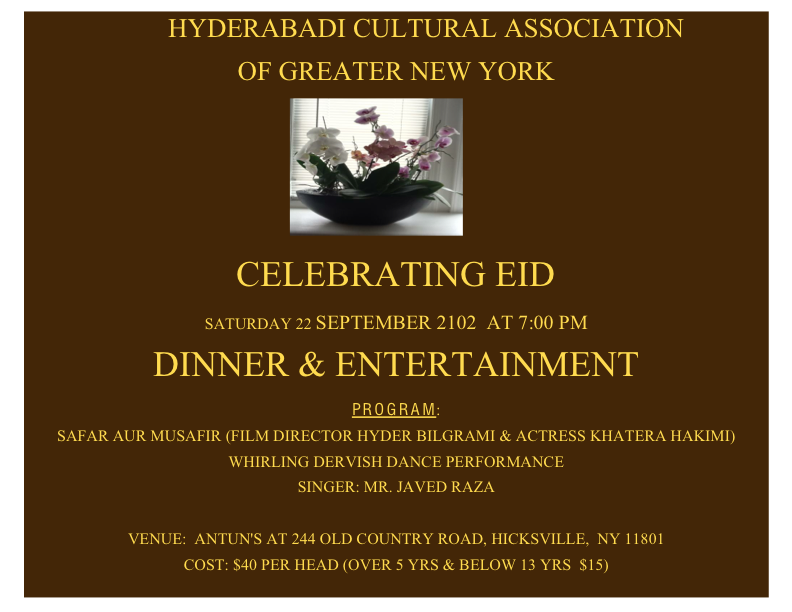
“CELEBRATING EID WITH HYDERABADI FRIENDS IS LIKE NOTHING ELSE IN THE WORLD” says Mr. Naimath Mohammed, Secretary

Thursday, October 11, 2012


For this Year Awards Night -Flair & Sophisticated Looks
                  
Two acclaimed honorees -who know how to make a statement -will show you how to dress with distinction as they stand at the podium to address two hundred or so guest who came to attend the annual event of Hicksville Chamber of Commerce at the Westbury Manor. Dr. Dev Ratnam received Presidents award and Mr Hussain Baqueri for the Community Service.

Dr. Dev Ratnam, is an entreprenuer and the President of the Rotary Club of Hicksville. He is also very well known in the community as a philanthropist and he serves on the board of several non profits. He is on the board and as a Trustee for Interfaith Nutrition Network since 1995. Had been on the Board of Indo American Cancer Foundation under and thanks to his efforts have an outstanding Cancer Hospital in Hyderabad. Associated with South Asian Council for Social Services in Flushing, New York as an enthusiastic supporter of its services for the recent South Asian Immigrants who need help in settling down in America. Dr.Ratnam, a Phd from Penn State University in solid state science, is originally from Hyderabad and presently lives in Brookeville with his wife Dr.Runi Ratnam and two children.

Mr Hussain Baqueri, who is a pilot, an entreprenuer and the Executive Vice President of Hyderabadi Cultural Association. He is also the Secretary for Nargis Dutt Cancer Foundation and member of several non profits on Long Island. Hyderabadis know Hussain for his service above self and pleasingly gentle personality. Hussain is married to Noor Baqueri and lives in Albertson.
                                                                   
                         On Your Mark, Get Set, Go & Win

In a separate event Mr Hussain Baqueri won the third place in Entenmann's South Bay 5k half marathon held on Saturday 6 October 2012 at Bayshore Marina. Entenmann promote health, wellness, exercise, and nutrition. Proceeds of the event will be used for Tri-ing for Kids (TFK) an organization of all individuals of all athletic abilities inspired to compete a personal goal for a cause greater then themselves. TFK raises money and awareness by completing endurance events to help provide financial support for children in need
.

Remarkable Diaspora: Krishna Madhuri Rallapalli


Humble, at the root. Madhuri Rallapalli is a real role model for inspiring our community. She walks two miles in the rain and cold to the Asamai Center in Hicksville where she volunteers on Sunday mornings. Started by Rotary Club’s philosophy of “Service Above Self”  Rota-Paal computer training Program,  where Madhuri passionately puts in hours of work to teach computers as a structured group instruction in Microsoft Word, Excel, Power Point, Outlook, Keyboarding, and Internet application to the South Asian adult community.
Madhuri arrived from Hyderabad last year with her husband and is already making a difference in the lives of several South Asians who need computer skills for employment or for their daily lives. Before coming to the USA Madhuri worked at Capgemini India for their investment banking advisory wing.

Madhuri is simply brilliant, dedicated and passionate about community, which is an excellent quality for a volunteer tutor, says Mr. Quddus Mohammed, who is the founder of Rota-Paal along with Mrs Vimmi Sikka, the Charter President of Rotary Club of Jericho Sunrise. "Adult education is challenging and she is a perfect fit for this" said Mrs. Arti Datta, a volunteer tutor for this program. “She is extremely proficient in MS Office but more importantly a uniquely pleasant”.

The Rota-Paal programs are aimed to provide guidance and learning to the South Asian adult immigrant Community on Long Island. The level one Computer classes started on September 15th is a six week program with focus on basic MS Office which include Word, Excel, resume writing or flyer making using Word Art Application. The response for the computer class was phenomenal, says Mr. Quddus " Our Service Above Self volunteers will agree with me to continue these sessions throughout the year based on specific skill level – beginner, intermediate, and advanced". The team is considering to start one day programs on specific topics for advance users like how to use Excel Pivot Tables or creating dynamic tables or dynamic charting for work environment. The best part of this program is that it is absolutely free.


Monday, August 20, 2012

Dallas Hyderabadi Association Wishes Eid Mubarak

EID GREETINGS

Socha kisi apne se baat karun,
Apne kisi khaas ko yaad karun,
Kiya jo faisla eid mubarak kehne ka,
Dil ne kaha kyun na HCA of Greater New York se shuruaat karun:)

Mere aur mere ahle-Khana ki janib se aap ko dili

*EID MUBARAK *

Arshad Nizam
Past President of Dallas Hyderbabadi Association

Saturday, August 11, 2012

HCA Marches in India Day Parade in Hicksville, Long Island

The President Mr. Quddus Mohammed and his wife Seema Zaki were holding the banner of Hyderabadi Cultural Association as they march in the India Parade in Hicksville, Long Island along with Mr Naimath Ullah and other friends.

The Long Island Indian community was extremely excited as they celebrated the first parade. The Bollywood celebrity star Vinod Khanna and his wife were the chief guests and several executives of Nassau County including County Executive Hon Ed Mangano attended the parade. Colorful floats and marchers holding Indian flags and over 2,500 community members marched in the parade as the Hicksville community distributed free water and cold drinks to the marchers as a mark of Indian solidarity.


Friday, August 10, 2012

Hyderabad'​s Charm Found in Ramadan Delights - NYTimes.co​m

Friday, August 10, 2012

Hyderabad’s Charm Found in Ramadan Delights


People break their fast outside the Mecca Masjid in Hyderabad, Andhra Pradesh, July 21, 2012.
Mahesh Kumar/Associated PressPeople break their fast outside the Mecca Masjid in Hyderabad, Andhra Pradesh, July 21, 2012.
 
Hyderabad, the Scottish historian William Dalrymple wrote, hides “its charms from the eyes of outsiders, veiling its splendors from curious eyes behind nondescript walls and labyrinthine backstreets.” But some secrets, like Hyderabad’s sinfully rich food, perhaps its greatest charm, are hard to keep. And the month of Ramadan is ideal for discovering the city’s most indulgent dishes.
A graceful, 400-year-old city, Hyderabad’s aristocratic order has given way to wealth born of industry, real estate and entrepreneurship. Once it became the capital of Andhra Pradesh, families from the traditionally Hindu coastal belts to the east populated the infertile, rocky city; then, with the boom in software and outsourcing, people began pouring in from all over India seeking jobs. Today’s Hyderabad is a curious mix of Hindu and Muslim, of native and settler, of old and new.

But the month of Ramadan, known as Ramzan in India, offers a peek into the city’s culinary past. When dusk arrives during Ramadan, with a shrill siren that signals the end of fasting, the narrow streets of Hyderabad’s old city fill up fast with vendors, shoppers and food buffs. What awaits the hungry are simmering pots of biryani with a distinctly Hyderabadi flavor; endless bowls of haleem — a thick, spicy paste of lamb and wheat, cooked to perfection; dried apricots and fresh cream served together as the wildly popular qubani-ka-meetha; and other flavors that carry the richness of a sultan’s sumptuous meal although they have been prepared in humbler kitchens.
"Haleem", a dish made of wheat and meat, is distributed during Ramadan in Hyderabad, Andhra Pradesh in this Sept. 22, 2008 file photo.Krishnendu Halder/Reuters“Haleem”, a dish made of wheat and meat, is distributed during Ramadan in Hyderabad, Andhra Pradesh in this Sept. 22, 2008 file photo.
 
Obscure restaurants light up their signboards promising the city’s best haleem – certainly the most sought-after dish at this time, partly because it’s not easily available for the rest of the year.
Mr. Dalrymple himself has recommended Salim, “the best biryani cook in Hyderabad,” in the opening pages of “White Mughals.” A decade after the book’s publication, Mr. Salim is hard to find, but there’s still plenty to choose from.

Hotel Shadab, a small, locally loved restaurant, is at its hopping best during Ramadan. Started in 1990, it has since added an air-conditioned upper floor for “ladies and families.” Rumored to serve the best haleem and biryani in town, the menu also offers fresh, soft loaves of sheermal and a decadent qubani-ka-meetha. The delicately flavored Pakistani chicken curry is a must.
Four Seasons, a restaurant that should not be confused with the luxurious hotel chain of the same name, is best known for its kebabs and biryani. But during Ramadan, its haleem, slightly spicier than most, is a hit. Fresh garlic naan goes best with the haleem. The almond kheer – milk, rice and sugar boiled together and seasoned with saffron and almonds – is a treat.

Pista House, Shah Ghouse, Sarvi and 555 are all famous for their haleem, doing a roaring business during Ramadan, as one can see from the line of vehicles waiting for takeaway orders.
The venerable Nizam Club is restricted to members only, but it brings so much to the table that it deserves a mention, especially during Ramadan. Few can cook biryani and haleem better than the chefs at this 128-year-old club established by the prime minister in Hyderabad’s erstwhile royal court. And nowhere else can you find some of the dishes on offer here, like dalcha, a sambar of meat and lentils flavored with tamarind, or the spicy, tangy mutton chutney.

But if you happen to find yourself in the city during Ramadan, do try and snag an invitation for an iftar, the evening meal after the fast is broken, or lunch on Id-al-Fitr, the day that marks the end of Ramadan, which falls on Aug. 18 this year. Hyderabad’s best restaurants notwithstanding, nothing can compare to a home-cooked meal. And it’s the best way to taste some of the more painstaking dishes, like sheer korma, a steaming pudding of milk and vermicelli, peppered with dates, which is considered an Id delicacy.

Wednesday, July 18, 2012

Shared Moments: Hussain Baqueri

Shared Moments :
19 May 2012 First Annual Gala Dinner
Dear Friends:
The happiest moments my heart knows are those in which it is pouring  forth its affections towards my  friends. The memory of  the night softens my heart. .
            I can never speak the power of shared laughter.
  Hussain Baqueri,
  Executive Vice President

A Royal Palace for Royal Books : Chowmahalla Palace

A Royal Palace for Royal Books : Chowmahalla Palace

The breath taking grandeur and style of the royal palaces constructed during the Asaf Jahi dynasty features the architectural past of 18th century Hyderabad. Chowmahalla Palace, one of the six sumptuously illustrated palaces, is located in densely populated medieval streets of old Hyderabad. Its grand arches, pillared grand hall, Italian marble statues and a marble royal seat Takht-e-Nishan was intended as the visible expression of the glory of the Nizams. Here the Nizams held their durbar and other religious and symbolic ceremonies. The masterpiece interior offer vivid insights in to Asif Jahi imperial classicism, traditions and deeper social insights of the time. Soon this will be the next home to the Royal library.

Chowmahalla palace was the royal seat of the Asaf Jahi dynasty and was also official residence of the Nizams VII. Architecturally modeled on Shah of Iran’s palace in Iran, the Chowmahalla or four palaces are walled within the vast gardens. The palaces are named Afzal Mahal, Mahtab Mahal, Tahniyat Mahal and Aftab Mahal. The three of the four palaces are single storied, while the main palace Afzal Mahal, is a two storied structure. The carefully fabricated architecture with elements of arts in its walls and ceilings and flowing from the ceiling 19 spectacular chandeliers of Belgian crystal is a symbol of royal extravagance. The two courtyards of the palace, a southern courtyard and a northern courtyard, provide a private and public space. The southern court yard host four palaces, while the Northern courtyard is a long series of rooms facing the fountain and pool to host visiting dignitaries.

HE. Asaf Ad-Dawlah, the third son of Asaf Jah initiated its construction in 1750, but it was completed by HE. Afzal Ad-Dawlah, the Nizam V between 1857 and 1869 in several phases. The exact date of construction is not known: no dated inscription or other source of information has survived. The palace originally covered 45 acres, extends from Lad bazaar in the north to Aspan Chowk in the south. But only 14 acres remain today.

Since the death of Nizam VI HE. Mir Mehboob Ali Khan in 1911 the palace was used as an official residence for foreign signatories. After the family fled in 1948, although the Palace was owned by the Asif Jah family, but it was largely disintegrated, disconnected and encroached. No one was permitted to even enter the palace gates, and gradually the palace fell into disrepair.

The present Nizam, Prince Mukarran Jah and his former Turkish wife Princess Esra showed appreciation of the monument and invited renowned architect Rahul Malhotra of RMA Architects, a Mumbai-based firm who recently completed a corporate campus project in The HITEC city of Hyderabad, to conserve and restore the Chowmahalla palace. The Princess personally oversaw every detail of the restoration project with aristocratic zeal. Rahul Malhotra said that the buildings were in a state of severe decay, damaged drainage system, molded plaster ceilings had caved in; floors of rare wood were rotting. After five years of restoration the palace opened to the public in early 2000. The visitors may step into history to gain understanding of the Asaf Jah Dynasty and also listen to the music records from Nizam’s private collection, which is played on an antique phonograph.

"The Princes gathering scattered papers dusting in the cellar of Nazri Bagh Palace, Chowmahalla Palace and Chiran Palace".


The Princess Esra has enthused scholars and historians by expressing their desire to house the treasure trove of Nizam's rare books, manuscripts and documents at the Mehtab Mahal of Chowmahalla palace belonging to sixth and seventh Nizam, reported Times of India. The library will also host eight volumes of Nizam's published poetry. A web directory is being created," said G Kishan Rao, Advisor of Chowmahalla palace. Spanning back to 16th century research scholars and historians will have access to this magnificent collection from the three Asaf Jahi palaces; Chowmahalla, Nazri Bagh and Chiran palace. There is a large collection of books and manuscripts at Falaknuma Palace library, which will be left at the location. The collection of Chiran Palace is the intellectual generosity of Prince Mukarram Jah, while the collection at Nazri Bagh is expected to be most important as this was the official residence of the Nizam until his death in 1967.

In 2,000 the Princess Esra contacted Amin Uddin Khan, a scion of Hyderabad nobility and a noted writer to take the project of saving documents dusting in the cellar of Nazri Bagh Palace. The books here are from all over the globe. The officials estimate that there are 5,000-6,000 books covering diverse subjects including history, art and culture. Several Islamic books are also part of the massive collection, including about 1,000 hand written copies of the Quran, some of which are 600 years. Among the documents also include royal decrees issued on variety of subject, correspondence between viceroys, details of visits of dignitaries and administrative records. These records date back to times of fifth, sixth and seventh Nizam, says Times.

Times of India reported that the team working on restoration found large numbers of pieces of papers over, which the Nizam had scribbled notes by pencil. A study of these documents may capture the moments of absolute importance to the history of what was going on in the mind of the Nizam who, after reaching pinnacle of power in 1937, had to merge his state into the Indian Union. The years, say between 1937 and 1948, are most crucial, writes Times.

The Chowmahalla palace’s advisor Mr. G Kishan Rao says "the library, which has already taken a decent shape will be consolidated and opened for research scholars soon. This, he believes, will help at relooking at Nizam, his contributions and the times more objectively".

Nizam VII, a poet himself, valued rare books, manuscripts, scholars and writers. He wrote poetry in Urdu and Persian. There is not much information available on his education but records of his early life tells us that eminent scholars were engaged to teach him English, Urdu and Persian languages. He enjoyed the company of intellectual elites and held endless series of discussions with scholars at his darbar. He was also tutored by Islamic scholars and acquired deep knowledge of theology. According to writer and historian Mr. Narendra Luther by the age 30 Nizam VII had already published 750 poems (ghazals) in six volumes. His last published poem was written in 1958 in Persian and was published in English news papers by the order of Prime Minister Jawahar Lal Nehru.

Nizam VII strongly believed in education of his people. He played a central role in introducing educational reforms that helped his generation and generations to follow. He cultivated education across his state through encouraging scholars and building of universities. He provided easy access to education by ordering establishment of schools and made primary education compulsory. He provided free education to the poor. Among the many buildings constructed during his reign include Osmania Hospital and Medical University, translation bureau and Osmania University. The forward-thinking ruler also made education of English language compulsory in universities. He supported institutions like the Telugu Academy for bringing out the book on Ancient Hindu buildings of Hyderabad, Banaras University, Aligarh University and Dar Uloom Deoband in Uttar Pradesh.

The legal advisor to Prince Mukarram Jah, Mr.Vijay Shankardass, says to read between the lines of Princess Esra’s efforts to restore palaces is not fair. While she owes her interest in palaces to her training in architecture, he says that it is in a constructive spirit she has restored the legacy of the Nizams. "Rest assured all this is being done on Mukarram Jah name,’’ he says, adding that one can’t fault her for carrying out the restoration of the Asaf Jah dynasty.

Written by:
Quddus Mohammed
President

Hyderabadi Cultural Association of Greater New York
Our Mission is to engage a diverse audience in the exploration of history and the distinct culture of Hyderabad.